
What Can’t You Store in a Storage Unit?
Most self-storage facilities don’t allow flammable or hazardous materials, perishable food, plants, animals, illegal or stolen goods, or people living in the unit. FreeUp Storage also prohibits firearms, liquids, combustible items, and aerosol cans. Lithium-ion batteries and tires aren’t banned across the board, so ask your facility before you pack them. Cars, boats, and RVs go in dedicated vehicle spaces.
If it can burn, leak, rot, or breathe, it stays out of your unit. Most storage facilities draw the line there, because one leaking paint can or open bag of birdseed can damage everyone else’s belongings too. This guide walks through what you can’t store, what you should ask about first, and what’s fine to pack. It also explains why facilities set these rules, what to do with items that can’t go in, and how to sort your things before moving day.
In This Guide
- Which Items Are Prohibited, Ask-First, or Fine to Store?
- Can You Store It? Check Your Item Here
- What Items Are Prohibited in Storage Units?
- Why Certain Items Are Restricted or Prohibited at Storage Facilities
- Can You Store Paint, Propane, or Gasoline in a Storage Unit?
- Can You Store Aerosol Cans or Liquids in a Storage Unit?
- Can You Store Food in a Storage Unit?
- Can You Store Plants or Pets in a Storage Unit?
- Can You Store Batteries in a Storage Unit?
- Can You Store Guns in a Storage Unit?
- Can You Store Tires, Engines, or Auto Parts in a Storage Unit?
- Can You Store a Car, Boat, or RV in a Storage Unit?
- What Can a Small Business Store in a Storage Unit?
- What Items Are Allowed in a Storage Unit?
- What Should You Do With Items You Can’t Store?
- Which FreeUp Storage Space Fits Your Needs?
- How Do You Check Your Items Before Packing?
- Frequently Asked Questions
- Need Help Confirming What You Can Store?
Which Items Are Prohibited, Ask-First, or Fine to Store?
The quick version. Details for each item follow below.
Not allowed
- Gasoline, propane, paint, solvents, pesticides
- Aerosol cans and household liquids
- Perishable food, plants, and animals
- Firearms, ammunition, and fireworks
- Firewood and charcoal
- Illegal or stolen goods
Ask first
- Lithium-ion batteries and e-bikes
- Loose tires, engines, and auto parts
- Sealed, shelf-stable food
- Equipment with a fuel tank
Usually fine
- Furniture and mattresses
- Clothing and linens in bins
- Electronics, backed up and boxed
- Books, kitchenware, and clean tools
- Seasonal décor and business supplies
- Cars, boats, and RVs in vehicle spaces
Not sure about an item?
Tell the local FreeUp Storage team what it is before you load the truck.
Can You Store It? Check Your Item Here
Select an item to see whether it’s allowed, needs approval first, or is fine to pack, along with the reason. The checker covers the items people ask about most. It’s a planning guide, so your rental agreement and your local FreeUp Storage team have the final say.
Choose an item above to see the answer.
What Items Are Prohibited in Storage Units?
The table shows whether each common item is allowed, with the reason behind each rule. “Not allowed” means it stays out of the unit. “Ask first” means it isn’t banned outright, but your facility may have conditions, so confirm before you pack it.
| Item | Allowed? | Why |
|---|---|---|
| Gasoline, propane, paint, solvents, pesticides, corrosive cleaners | Not allowed | Gasoline and propane are flammable, and leaking paint or chemicals can damage belongings or release harmful fumes.[1] |
| Aerosol cans and household liquids | Not allowed | Pressurized cans can burst in heat, and leaking liquids can soak and ruin nearby boxes. |
| Fireworks, ammunition, gunpowder | Not allowed | These ignite easily and can cause fires or injuries. |
| Firewood, charcoal, other combustibles | Not allowed | They burn easily, and firewood can also bring insects and moisture into a unit. |
| Perishable food, open pet food, birdseed | Not allowed | Food attracts rodents and insects, which can contaminate belongings.[2] |
| Plants, pets, other animals | Not allowed | Damp soil adds moisture, and animals need air, water, and care that a unit can’t provide.[5] |
| Illegal or stolen goods | Not allowed | Storing them is unlawful, and a rental agreement doesn’t change that. |
| Living or sleeping in the unit | Not allowed | Units are built for belongings, with no plumbing, ventilation, or safety features for living space. |
| Firearms | Not allowed | Firearms are a safety and liability concern in a building shared by many renters. |
| E-bikes, scooters, spare lithium-ion batteries | Ask first | A damaged or overheating battery can catch fire, so facilities set their own rules.[3] |
| Loose tires, engines, automotive parts | Ask first | They can hold fuel or oil, and some facilities have their own preparation rules. |
| Cars, boats, RVs, trailers | Allowed in vehicle spaces | FreeUp Storage offers dedicated spaces at many locations. Never idle an engine in an enclosed space.[6] |
| Furniture, clothing, electronics, everyday household goods | Allowed | They don’t burn easily, leak, or attract pests, as long as they’re clean and dry. |
Why Certain Items Are Restricted or Prohibited at Storage Facilities
Every restriction traces back to a few risks that affect your belongings and the units around you.
Fire
Gasoline, propane, aerosols, firewood, fireworks, and damaged batteries can ignite or feed a fire.[3]
Leaks and fumes
Paint, solvents, pesticides, and other liquids can leak, damage belongings, and give off harmful fumes.[1]
Pests
Food, open pet food, and birdseed attract rodents that can contaminate belongings.[2]
Moisture
Damp soil, plants, and wet items add moisture, and mold needs moisture to grow.[5]
Can You Store Paint, Propane, or Gasoline in a Storage Unit?
Paint, propane, and gasoline top nearly every prohibited list for the same reason: they’re flammable, and a storage building is full of other people’s belongings. Gasoline gives off vapors that ignite easily. Oil-based paints, thinners, and many pesticides and cleaners are flammable or corrosive, and some give off harmful fumes if they leak or mix.[1] Household hazardous waste programs use label words like flammable, corrosive, and toxic to flag these products, so the can itself usually tells you.
Equipment is the easy one to miss. A mower, generator, or pressure washer can still hold fuel in its tank, and a propane cylinder can contain gas even when it feels empty. If you’re moving equipment like that, ask your facility how it wants it prepared before you load the truck.
Leftover paint and chemicals are easiest to deal with before you pack. Your local household hazardous waste program accepts them, ideally in the original labeled containers and never mixed together or poured down the drain.[1] Waste from a business can follow different rules, so check with your local waste authority.
Can You Store Aerosol Cans or Liquids in a Storage Unit?
No. Aerosol cans and liquids are not allowed in storage units, including at FreeUp Storage. Aerosol cans are pressurized, and many contain flammable propellants. Heat can make a can burst, and a flammable propellant adds fire risk.
Liquids are a different problem. Bottles can leak, tip over, or freeze and crack. A leaking bottle of cleaner, cooking oil, or juice can soak cardboard boxes and stain or ruin whatever sits next to it.
Check your kitchen, bathroom, and garage for items like hairspray, spray paint, cooking spray, bleach, and partly used bottles. Use them up, give them away, or dispose of them properly before moving day. Containers you want to keep, like a pitcher or glass jars, are fine once they’re empty and dry.
Can You Store Food in a Storage Unit?
Perishable food doesn’t belong in a unit, and the reason is as much about rodents as spoilage. Rodents are drawn to food, and they can contaminate belongings with droppings and urine.[2] Open bags of dog food or birdseed attract them as well as groceries do, so they stay out too.
Coolers and kitchen appliances can hold crumbs and spills you can’t see. Wipe them down and let them dry before you pack, so nothing inside gives pests a reason to visit. Sealed, shelf-stable food is a gray area and facilities differ, so ask before you bring it. Where it’s allowed, thick plastic, metal, or glass containers with tight lids make it harder for pests to get in.[2]
Can You Store Plants or Pets in a Storage Unit?
No. Plants and animals both need things a storage unit can’t give them.
Plants need light, water, and fresh air, and damp potting soil adds moisture to a closed space. Mold needs moisture to grow.[5] Take your houseplants with you or ask a friend to look after them, and empty, clean, and dry your planters before you pack them, since leftover soil holds moisture.
Pets are a firmer no. A standard unit has no airflow, no water, and no food, and nobody is there to check on an animal. Temperatures inside can climb or drop past what an animal can handle, and a closed space can become dangerous quickly. That applies to every kind of animal, not just dogs and cats. Fish, reptiles, birds, and small pets can’t be left in a unit either, even for a short time.
Moving with a pet takes its own plan. Keep your pet with you or with someone you trust, and book boarding or a pet sitter for moving day if you need one. Crates, cages, and empty tanks can go in storage once they’re clean and dry, but the animal can’t.
Can You Store Batteries in a Storage Unit?
Ask first. Batteries are not a flat yes or no, because the answer depends on the type of battery and the facility’s policy. Lithium-ion batteries carry the most risk. They power e-bikes, scooters, power tools, laptops, and portable power stations, and a damaged or overheating one can catch fire.[3] In a building full of other people’s belongings, facilities take that seriously, so some accept these items and some don’t. Large batteries, like those from a car or boat, are worth asking about too.
When you ask, say whether the battery is built in or removable and how many you have. Keep spares away from anything that can burn, and follow the manufacturer’s storage directions for any equipment the facility accepts. Don’t plan to charge devices inside your unit.[3]
Some batteries shouldn’t go into storage at all. If one has an odor, changes color or shape, leaks, makes odd noises, or gets too hot, stop using it and contact the manufacturer for handling instructions.[3] Old lithium-ion batteries don’t belong in household trash or curbside recycling either. Take them to a battery recycling or household hazardous waste collection point.[4]
Can You Store Guns in a Storage Unit?
No. Firearms are not allowed in most storage units, including at FreeUp Storage. Ammunition, gunpowder, and fireworks are off limits at standard facilities as well, because they add fire and injury risk.
A storage property holds belongings from many different renters, which is why firearms are treated as a safety and liability concern there. Policies still vary by operator and location, so read the rental agreement before you assume a rule from one facility applies at another.
If you need a place for a firearm during a move or a downsize, look at options built for that. A home gun safe, a licensed dealer that offers storage, or a trusted family member who can legally hold it are common choices. Check your local laws before you transfer or transport a firearm.
Can You Store Tires, Engines, or Auto Parts in a Storage Unit?
Ask first. Engines, transmissions, and other automotive parts can still contain oil, fuel, or coolant, and those fluids can leak onto the floor of a unit and onto whatever sits near it. Tires are a lower risk, but they take up more room than most people expect, and some facilities set their own rules for them.
Tell the facility what you have and how many, and ask how it wants the items prepared. Draining fluids, wiping parts down, and capping or bagging anything that could drip is a good start. Keep tires on a pallet or shelf, off bare concrete and away from heat sources.
Can You Store a Car, Boat, or RV in a Storage Unit?
FreeUp Storage offers dedicated vehicle, RV, and boat spaces at many locations, in covered and uncovered options, so your vehicle doesn’t need to fit in a standard unit. Covered spaces add protection from sun and weather, so the right choice depends on what you’re storing and how long it will sit.
Measure before you rent. Include the hitch on a trailer and the height of any roof attachments, then ask about clearance and turning room so you know you can get in and out easily. Ask about paperwork too, and about the facility’s rules for fluids and batteries.
One rule never changes: don’t run a vehicle or fuel-powered equipment inside an enclosed space. Engine exhaust contains carbon monoxide, and it can build up where air can’t move.[6] Explore boat storage or RV storage.
Need space for a vehicle?
Browse RV and boat storage at FreeUp Storage locations.
What Can a Small Business Store in a Storage Unit?
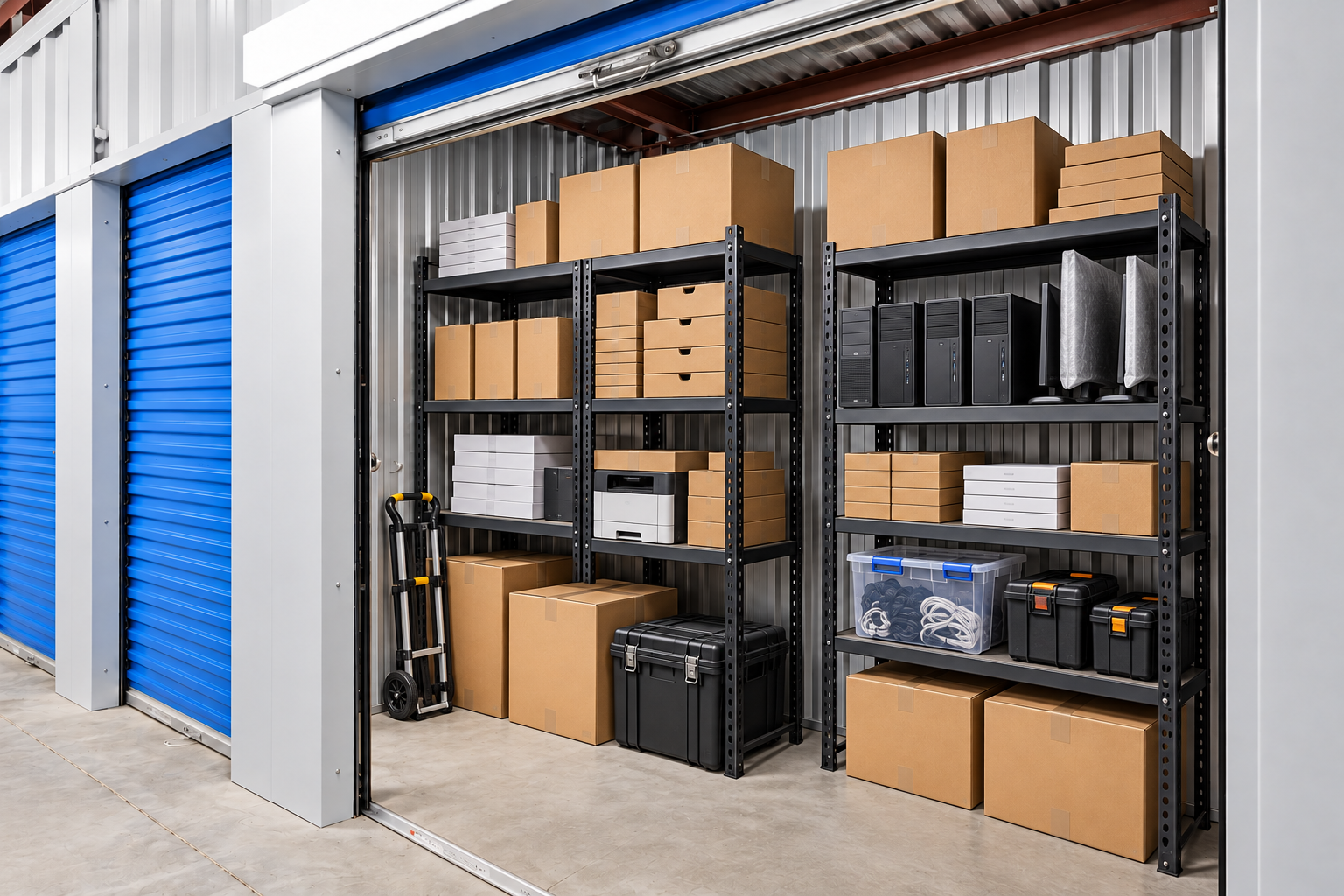
Small businesses use storage units to keep inventory, supplies, and equipment out of office, retail, and garage space. Good fits include boxed merchandise, shelving, display fixtures, seasonal stock, trade show materials, tools, and paper records in sealed boxes. Shelving and clear labels by product or order date help you grab stock without unpacking a pallet.
Business inventory follows the same rules as personal items. A stock of food, chemicals, aerosols, or batteries doesn’t get a pass because it’s for a business, so check your inventory against the prohibited list before you move it in.
Check what the facility allows before you rent. Ask separately if you plan to assemble products, repair equipment, ship orders from the unit, or meet customers there, since those uses can come with their own rules.
What Items Are Allowed in a Storage Unit?
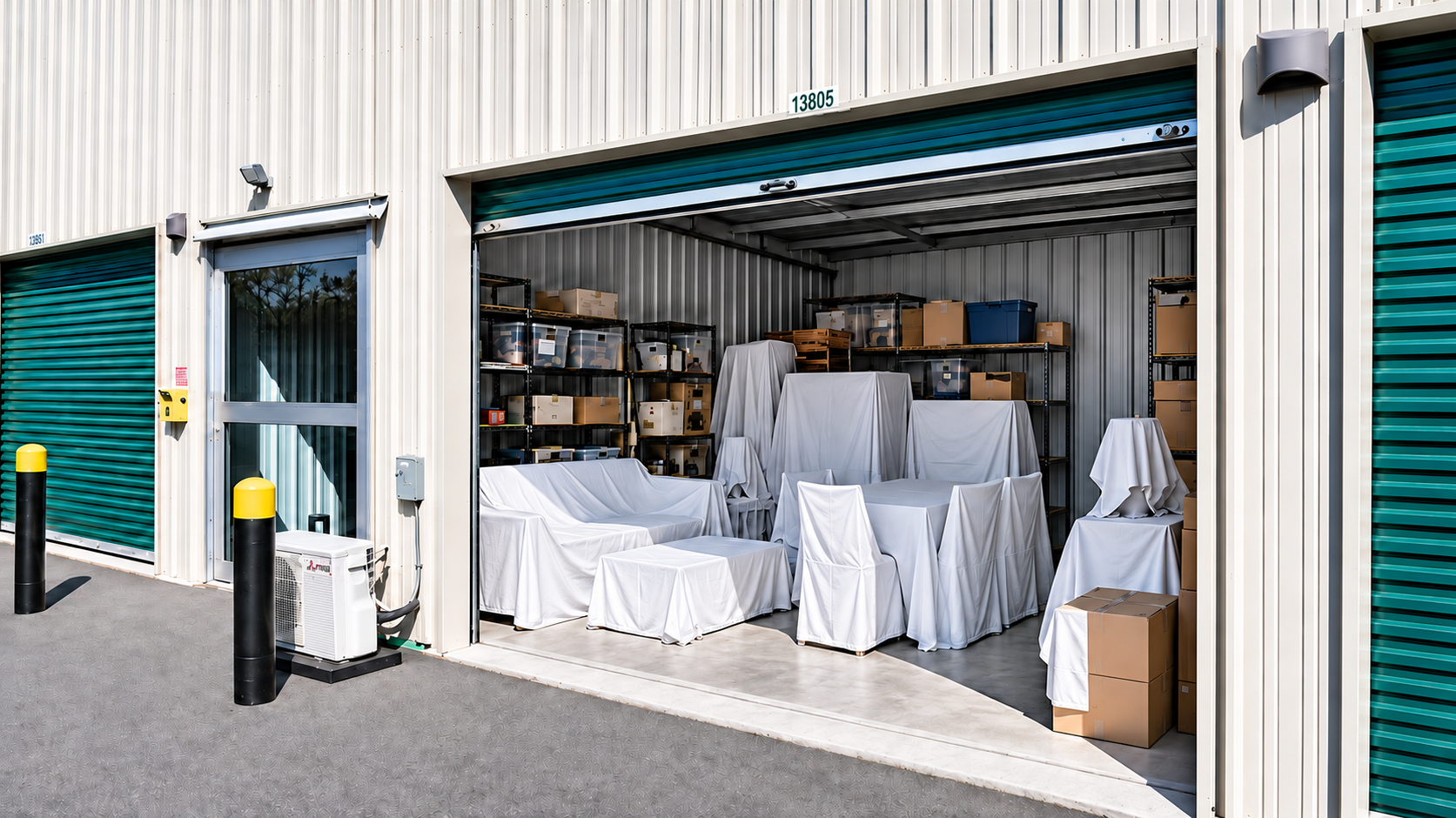
Most everyday belongings are welcome in a storage unit: furniture, mattresses, clothing, electronics, books, kitchenware, and seasonal gear. These items don’t burn easily, leak, or attract pests, which is why facilities accept them.
How you pack matters as much as what you pack. Let anything damp dry fully first, since trapped moisture is how mold starts.[5] Label boxes on two sides, put heavy boxes on the bottom, and leave an aisle down the middle so you can reach the holiday lights without unloading half the unit.
For wood furniture, electronics, and photos, consider climate controlled storage to protect against temperature swings. Our guide explains whether you need it.
What Should You Do With Items You Can’t Store?
Items that can’t go in your unit still need somewhere to go, and some of them, like paint and batteries, shouldn’t go in the regular trash. Most have a simple solution: a household hazardous waste program, a recycling drop-off, or a friend who can take them for now. The table below shows a better option for each common item, so you can sort them out before moving day.
| Item | Better option |
|---|---|
| Paint, solvents, pesticides | Take them to a household hazardous waste program in their original labeled containers.[1] |
| Aerosol cans and propane cylinders | Use up what you can, then ask your local hazardous waste program about the rest.[1] |
| Lithium-ion batteries | Use a battery recycling or household hazardous waste collection point.[4] |
| Perishable food | Eat it, share it, or donate unopened items before you move. |
| Plants | Move them with you or ask someone to care for them. |
| Pets | Arrange care or travel with them separately. |
Which FreeUp Storage Space Fits Your Needs?
Standard unit
Furniture, boxes, seasonal gear, and business supplies that follow the rules above.
Find a storage unitClimate controlled unit
Wood furniture, electronics, and photos that need protection from temperature swings.
See climate controlled unitsVehicle, RV, and boat space
Cars, boats, RVs, and trailers in dedicated spaces at many locations.
Explore vehicle storageNot sure what size unit you need?
Use the FreeUp Storage calculator to estimate how much space your belongings will take up.
How Do You Check Your Items Before Packing?
Sort
Pull out anything flammable, liquid, pressurized, or perishable.
Read labels
If a label says flammable, corrosive, or toxic, leave it out.
Ask first
Tell the local team about batteries, tires, and equipment with fuel.
Before you rent, confirm:
- The prohibited-items list in your rental agreement
- Whether your location has vehicle spaces and accepts batteries or tires
- Whether fuel-powered equipment needs to be drained first
- Where to take leftover chemicals and batteries
Frequently Asked Questions
Can you live in a storage unit?
No. Living or sleeping in a storage unit breaks the rental agreement at virtually every facility, and it conflicts with most local zoning and fire codes. Units have no plumbing, ventilation, heating, or fire protection designed for people, so the risks include carbon monoxide, fire, and no way to escape quickly. A facility that finds someone living in a unit can end the rental agreement. If you need short-term housing during a move, look at extended-stay hotels or short-term rentals instead.
Can you store a mattress or couch in a storage unit?
Yes. Mattresses, couches, and other furniture are some of the most common items people store. Clean them and let them dry completely first, because trapped moisture causes mold and odors. Cover them with a breathable cloth or cotton sheet instead of plastic, which holds in humidity. Keep mattresses flat or upright and off the floor, and leave an aisle so you can reach everything without moving heavy pieces.
Can you store electronics in a storage unit?
Yes. Electronics are allowed in storage units, but heat, cold, and humidity can damage them. Back up your data, remove batteries, and pack items in their original boxes or padded containers. Make sure everything is dry before you pack. For TVs, computers, and other sensitive equipment, climate controlled storage keeps temperature and humidity steady. Lithium-ion batteries are handled separately, so check your facility’s rules before storing them.
Can you store important documents or photos in a storage unit?
Yes, but keep irreplaceable originals with you. Passports, birth certificates, Social Security cards, and vehicle titles can take weeks or months to replace, and you may need them on short notice. Paper and photos are also vulnerable to humidity, which causes mold, warping, and sticking, and to temperature swings, which cause fading and brittleness. Store copies and non-essential papers in sealed plastic bins or archival boxes, keep them off the floor, and use climate controlled storage for photos and records you want to preserve.
Can you store firewood or charcoal in a storage unit?
No. Firewood and charcoal are combustible, so storage facilities prohibit them. Charcoal can also self-heat and smolder when it is damp or kept in a hot space, and firewood brings moisture, mold, and insects into a unit that can spread to other belongings. Keep firewood outdoors, covered, raised off the ground, and away from your house. Buy charcoal as you need it and store it in a dry, ventilated spot at home.
Do I need to tell my storage facility what I'm storing?
You don’t have to list every item, but you must not store anything prohibited, and you should tell the facility about anything you’re unsure of. Your rental agreement makes you responsible for what is in your unit and lists the items that are not allowed. Items on the ask-first list, such as batteries or tires, vary by facility, so a quick call or email to the local team confirms what is allowed before you pack. Storing a prohibited item can break your rental agreement and may affect an insurance claim.
What happens if you put a prohibited item in storage?
The facility can require you to remove the item, charge fees, or end your rental agreement, depending on the terms you signed. If the item causes a fire, leak, or pest problem, you can be held responsible for damage to other tenants’ belongings and the property. If you realize you’ve stored something prohibited, remove it as soon as you can and dispose of it properly. Chemicals, paint, propane, and batteries usually go to a household hazardous waste drop-off, and your local waste authority can tell you where.
Can climate controlled storage make prohibited items safe to store?
No. Climate control manages temperature and humidity, but it does not remove the fire, fumes, pest, or legal risks that make an item prohibited. Gasoline, propane, paint, firewood, and food stay prohibited in every unit type. Climate controlled storage is useful for allowed items that are sensitive to heat, cold, or moisture, such as wood furniture, electronics, documents, photos, artwork, and musical instruments.
Need Help Confirming What You Can Store?
The rules for each facility are written into its rental agreement, and the local team can tell you how they apply to your items. Before you rent, ask for the prohibited-items list and mention anything unusual, like batteries, tires, or equipment with fuel. Once your items are sorted, our storage unit size guide and storage calculator can help you pick the right size.
Talk to your local FreeUp Storage team
Find a location near you and confirm what’s allowed before you rent.
Sources
- U.S. Environmental Protection Agency. (2026, June 1). Household hazardous waste (HHW). https://www.epa.gov/hw/household-hazardous-waste-hhw
- Centers for Disease Control and Prevention. (2024, April 8). How to seal up to prevent rodents. https://www.cdc.gov/healthy-pets/rodent-control/seal-up.html
- U.S. Fire Administration. (2024, November 7). Battery fire safety. Federal Emergency Management Agency. https://www.usfa.fema.gov/prevention/home-fires/prevent-fires/batteries/
- U.S. Environmental Protection Agency. (2026, March 20). Used lithium-ion batteries. https://www.epa.gov/recycle/used-lithium-ion-batteries
- U.S. Environmental Protection Agency. (2026, February 18). A brief guide to mold, moisture and your home. https://www.epa.gov/mold/brief-guide-mold-moisture-and-your-home
- Centers for Disease Control and Prevention. (2026, October 26). Carbon monoxide (CO) poisoning basics. https://www.cdc.gov/carbon-monoxide/about/index.html